
What Do We Owe People When Sharing Their Stories Carries Risk?
The uncomfortable gap between honest conversation and meaningful action.
Unsinkable Storyteller: Manal Sayid, MBA, Founder & President of Sayid Consulting.

In the coming weeks, Manal’s story will also be published in Lamplight Magazine, in print & digital. Lamplight is an Unsinkable publication founded & edited by Publications Lead, Mikaela Brewer, to be a home for mental health care providers. It’s published digitally throughout the year, and once in print every October 13th.

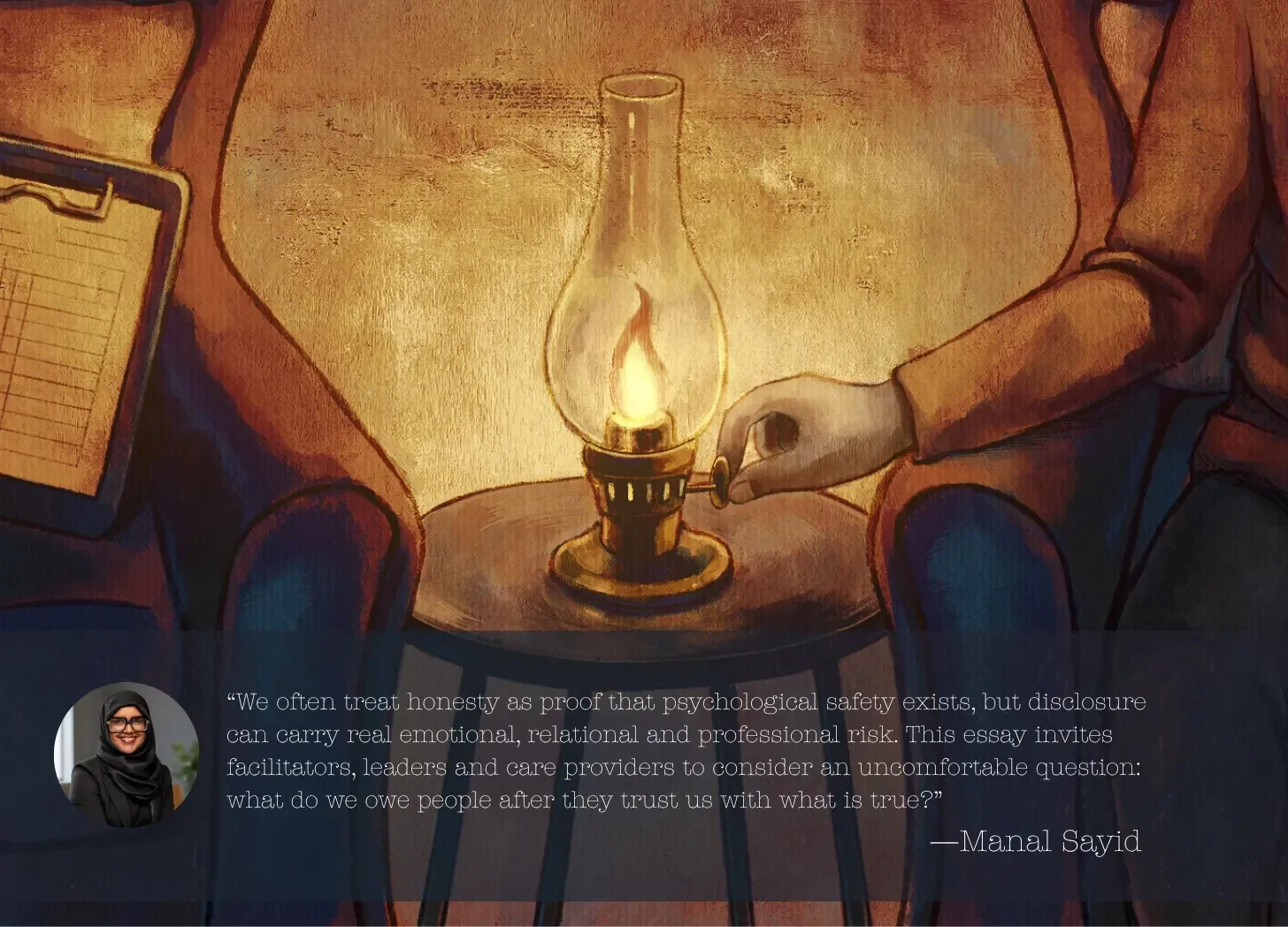
We often treat honesty as proof that psychological safety exists, but disclosure can carry real emotional, relational and professional risk. This essay invites facilitators, leaders and care providers to consider an uncomfortable question: what do we owe people after they trust us with what is true?
There is a particular moment that people who hold space learn to recognize. Someone stops speaking in the polished language of meetings, consultations and “appropriate workplace communication.” Their voice changes, the answer they prepared gives way to the answer underneath it, and the room becomes very still.
We often call this vulnerability. Sometimes we call it a breakthrough.
Sometimes someone says, “Wow, thank you for sharing that,” which is often sincere and occasionally the organizational equivalent of placing a decorative pillow over a structural crack.
We tend to read these moments as evidence that we have done something right. We created trust, we lowered defenses, we made it possible for someone to tell the truth.
Sometimes that’s exactly what happened, but I have increasingly found myself wondering about the bargain hidden inside that moment:
Why did this person have to reveal something so personal before the room understood the seriousness of what they were saying?
Why did pain have to become visible before the system became responsive?
Why do we so often judge the safety of a space by how much people are willing to disclose inside it?
We confuse psychological safety with access to other people’s interior lives.
That’s an uncomfortable thought, particularly for those of us whose work involves inviting people to speak. For precisely that reason, it’s one we need to sit with.
When “Opening Up” Becomes the Goal
We live in a culture that places enormous value on disclosure. We encourage people to tell their stories, bring their whole selves, name what’s really happening and allow themselves to be seen.
These invitations can be deeply generous. A story can interrupt isolation and give another person language for something they believed they were experiencing alone. For care providers, facilitators and community leaders, witnessing someone move from concealment toward connection can feel profoundly meaningful.
It can also make us feel effective.
There it is. The honest thing. The hidden thing. The thing beneath the thing.
Facilitators love “the thing beneath the thing.” We’re professionally unable to leave a metaphor unexcavated.
However, an invitation to open up never occurs outside power. A client and care provider occupy different roles, even when their relationship is warm and collaborative. An employee participating in an organizational review knows that someone hired the interviewer and will eventually receive the findings. A community member may be describing harm to an institution that will decide whether that harm warrants action.
Even the most compassionate invitation can therefore carry an unspoken demand: help us understand by showing us how much ‘x’ hurt.
The person is no longer being asked to only contribute knowledge. They may feel required to translate private pain into evidence that others will find credible. Their experience becomes a story, the story becomes a theme and the theme becomes a bullet point under “organizational culture.”
Everyone nods gravely. Someone writes “trust” on a sticky note. The meeting ends at 3:30.
The story travels outward, while the person who told it goes home carrying the consequences of having made it public.
This is where storytelling can become extraction, even when everyone involved is kind, well-intentioned and using excellent markers.
Silence May Be a Boundary, Not a Failure
Our conversations about psychological safety often position speaking as healthy and silence as a problem to solve.
Certainly, silence can come from fear. People withhold concerns when they’ve watched honesty be punished, ignored or quietly used against someone. They learn from what happens to the last person who spoke.
Organizations are always teaching people whether it’s safe to tell the truth. They teach through policies, but mostly through consequences.
Was the person thanked publicly and sidelined privately?
Was their feedback welcomed, then reframed as a problem with their tone?
Were they described as courageous in the meeting and difficult in the debrief?
People notice, but silence can also carry other meanings. It can be discernment, privacy or self-protection. It can be someone accurately concluding that the room has not earned a particular story. It can be a person deciding that an experience is still too tender, too complicated or too easily misunderstood to be offered for collective examination.
Sometimes silence is simply someone thinking, “Absolutely not. You people have not demonstrated the range.”
That may not be disengagement. That may be wisdom.
Silence can also be a refusal to turn one’s life into a curriculum for people who have not demonstrated that they will act differently once the lesson is over.
This distinction matters because when we assume everyone should speak, we make disclosure the standard and privacy the deviation. We begin to interpret boundaries as resistance, mistrust or a lack of readiness.
Yet a psychologically safe space should not merely make speaking possible. It should also make declining to speak permissible.
A person should be able to participate without offering their most intimate experiences. They should be able to name a concern without explaining every wound beneath it. They should be able to say, “This is harmful,” without immediately being asked to produce an emotionally compelling origin story.
The Mask May Have Been Doing Important Work
We often speak about masks as though they are inherently false. Beneath the professional voice, the composure and the carefully chosen answer, we imagine a more authentic self waiting to be released.
Removing the mask is treated as liberation, but masks are not always evidence of dishonesty. Sometimes they’re technologies of survival.
A person may have learned to manage their facial expression because visible emotion has repeatedly been interpreted as instability. They may speak in restrained language because their directness has been racialized, gendered or described as aggression. They may carefully separate their personal and professional lives because previous openness altered how colleagues understood their competence.
For people moving through institutions that were not designed with them in mind, self-editing can be exhausting, but it can also be intelligent.
Before we invite someone to remove the mask, we should ask what that mask has been doing for them. What has it protected? What consequences has it helped them avoid? What happens when the facilitated conversation ends and the person returns to an environment that still rewards the performance they were briefly encouraged to abandon?
It’s one thing to say, “Bring your whole self”, and it’s another thing entirely to meet the whole self when it arrives irritated, skeptical, grieving, unconvinced and not especially interested in making leadership feel comfortable.
Many organizations want authenticity in theory. In practice, they would prefer authenticity to be warm, concise and solutions-oriented.
Care cannot mean celebrating someone’s unmasking while leaving untouched the conditions that made the mask necessary.
The Trauma Receipt
In my work with organizations navigating strategy, culture and change, I often encounter a troubling pattern. A concern may be raised quietly for months, but it becomes legitimate only when someone offers a sufficiently affecting personal story.
Data may show that workloads are unsustainable, yet the issue becomes real when an employee cries.
Turnover may reveal an obvious pattern, but leaders take notice only when a former staff member describes what the culture cost them.
Community members may repeatedly identify an inequitable practice, but urgency arrives only after someone recounts an intimate experience of being harmed by it.
Apparently, the spreadsheet was not sad enough.
We should be careful not to build systems in which people must produce what I call a trauma receipt: Personal proof of suffering offered in exchange for institutional concern.
People should not have to expose the most difficult parts of their lives to establish that a policy is harmful, a workload is unreasonable or a decision excludes them. Their stories may deepen our understanding, but those stories should not be the admission price for being believed.
This is especially important in mental-health and social-purpose work, where lived experience is rightly recognized as a valuable form of knowledge. It can illuminate what professional education, positional authority and quantitative evidence fail to reveal.
However, valuing lived experience does not entitle an organization to unlimited access to it.
The knowledge belongs to the person before it becomes useful to the institution. They retain the right to decide what will be shared, how it will be interpreted and whether they wish to be known through that experience at all.
No one owes an institution the most painful chapter of their life simply because the institution has recently discovered the phrase “lived expertise.”
A Moving Conversation Is Not Necessarily Movement
Social-purpose organizations frequently understand themselves as caring institutions. Their missions are rooted in healing, equity, justice, belonging and community.
The values page is usually excellent. The challenge is what happens after the values page.
Organizations conduct interviews, hold listening circles and invite people to describe their experiences of culture, burnout, trust or exclusion. These processes can reveal dimensions of organizational life that no dashboard could capture.
Participatory planning matters because people are not abstract stakeholders. They possess knowledge formed through relationships, experience and proximity.
However, participation becomes hollow when people are repeatedly asked to describe conditions the organization is not prepared to change.
A story is not implementation, a listening session is not accountability, feeling moved by someone’s experience is not the same as altering a policy, redistributing authority, funding an idea or repairing a relationship.
Organizations can become remarkably skilled at receiving stories while remaining largely unchanged by them. Here is what usually happens:
The session is described as powerful.
The facilitator is thanked for creating a safe space.
The findings are distilled into themes such as communication, trust and wellbeing.
A report is circulated.
Everyone agrees there is more work to do (there is always more work to do; it’s the most renewable resource in organizational life).
Then the organization proceeds with decisions that were already mostly made.
The emotional depth of the conversation creates a feeling of movement even when very little has structurally moved.
This may be the more consequential paradox of psychological safety: A room can feel deeply human while the system surrounding it remains untouched.
Safety Is What Happens After the Truth
We frequently evaluate a conversation by what took place inside it. We ask whether people participated, whether they spoke candidly and whether previously unspoken tensions were finally named.
These questions matter, but they tell us very little about the eventual consequences of speaking.
Psychological safety is better evaluated by what happens after the truth enters the room:
Is the person treated differently?
Are they protected when their honesty unsettles someone with greater authority?
Do leaders follow up after receiving difficult feedback?
Are findings returned to the people who contributed them?
Can participants recognize a connection between what they shared and what the organization ultimately decides?
Or does everyone simply praise the honesty and then become mysteriously unavailable when accountability arrives?
People don’t need every suggestion to be adopted. Meaningful participation doesn’t mean that every decision becomes unanimous or that every sticky note becomes a strategic priority.
People do, however, deserve evidence that their contribution travelled somewhere. They deserve a visible line between what was shared, what was understood and what will happen next.
Without that line, the organization retains the story while the storyteller retains the risk.
Psychological safety should therefore be understood less as an atmosphere that encourages disclosure and more as a relationship that protects agency.
People need control over what they share, how quickly they share it, the form their participation takes and whether a personal experience becomes part of a larger organizational narrative.
Some people think aloud. Others need time. Some will speak more honestly in a group. Others would rather be launched directly into the sun. Some want their experience witnessed. Others want the issue addressed without becoming the face of it.
A humane process does not demand a single performance of courage. It creates several ways for people to contribute without surrendering ownership of themselves.
Care for the People Holding the Room
There is also another mask in the room: The one worn by the person holding it.
Care providers, facilitators and organizational leaders are often expected to possess an almost endless capacity for presence. They listen, regulate their reactions, interpret complexity and help other people feel that difficult experiences can be contained.
Because this work is often performed calmly, its emotional cost can become invisible.
The person holding the conversation may leave carrying fragments of many stories while believing that professionalism requires those stories not affect them. They may interpret their own need for rest, support or silence as evidence that they are not sufficiently resilient.
Organizations reinforce this when they praise compassion while failing to fund the conditions that sustain it.
The language of mission and purpose can make overextension feel noble. Commitment becomes a reason to tolerate poor boundaries. The ability to hold others becomes an argument for being given more to hold.
The reward for being good at emotional labour is often, unfortunately, more emotional labour. Yet the people providing care are not infrastructure. They are not endlessly renewable resources. A system cannot accurately describe itself as caring simply because care occurs somewhere inside it.
It must also examine how that care is resourced, reciprocated and sustained.
I felt some of this tension while writing this essay.
There is an obvious invitation available to me here: Tell you a personal story. Offer a moment when I felt exposed, when I watched someone take a risk in a room I was holding, or when I carried something home that was heavier than I expected. A story might make these ideas more vivid. It might make me more credible. It would certainly make this essay more personal.
Yet I find myself resisting the assumption that I need to give you one. That resistance feels relevant.
Those of us who facilitate, provide care, lead communities, or work from lived experience can become particularly easy people to ask for stories. Our proximity to an issue can quietly become an expectation of disclosure. We are invited not only to know something, but to demonstrate how we came to know it.
Perhaps the same question I am asking organizations belongs here too: How much of ourselves must we reveal before what we know is allowed to stand on its own?
I believe deeply in the power of stories. I also believe we should be able to choose which ones remain ours.
Build a Room That Requires Less Courage
We often praise people for being brave enough to speak, and there is something beautiful about honouring courage. However, an emphasis on individual bravery can distract us from the quality of the environment.
Why was so much courage required?
Why did telling the truth carry so much risk?
Why was the burden placed on the person with less power to transform the conversation?
The strongest participatory processes do not simply invite courage. They reduce the amount of courage required.
They establish confidentiality clearly.
They offer several ways to contribute.
They explain exactly how information will be used.
They distinguish listening from therapeutic care.
They avoid promising a level of safety that no facilitator or organization can guarantee.
They prepare leaders to receive difficult feedback without immediately becoming defensive, which is a skill many people support wholeheartedly for other leaders.
They return findings to participants and connect what was heard to decisions, resources and accountability.
That is how psychological safety becomes more than a temporary feeling in a well-facilitated room, it becomes part of how an institution behaves.
Stories can connect us. They can loosen shame and give us language for experiences we thought belonged only to us, but stories are not raw material.
They come from people whose privacy may be as meaningful as their visibility, whose silence may contain wisdom and who may want change without wanting exposure.
People should not have to tell the worst thing that happened to them before the rest of us become willing to make the room better.
The ethical question is not only whether we can help people open up; we must also ask what we’ve done to earn the truth, what we’re prepared to change because we heard it, and whether we can build systems humane enough that no one has to reveal a wound simply to prove that something hurts.
Maybe the most psychologically safe room is not the one where everyone finally tells us everything, maybe it’s the one where they don’t have to.
Manal Sayid is a dedicated advocate for driving meaningful outcomes and empowering social change. With an MBA and over a decade of experience in business and change management, she specializes in strategic planning, facilitation, and fostering human-centred, participatory approaches.
Manal Sayid serves as the North American Regional Director for the International Association of Facilitators (IAF), where she provides leadership in advancing the profession of facilitation across the region. In this role, she works with a diverse network of facilitators, supporting professional development, promoting standards of excellence, and fostering connections within the facilitation community.
Additionally, as a Board member of the Technology of Participation (ToP)®️ Network, Manal contributes to the development and dissemination of facilitation methods designed to promote inclusive decision-making and meaningful collaboration. She is actively involved in advancing the use of structured, participatory approaches that help organizations and communities address complex challenges and achieve their goals effectively. Manal’s ethos is grounded in authenticity and community empowerment. Her collaborative approach helps organizations align their teams, navigate complexity, and achieve results that are both tangible and transformative. Renowned for her ability to unite diverse stakeholders, Manal excels in tackling intricate challenges that demand creativity and unconventional thinking. Her facilitation work is guided by a commitment to inclusion, ensuring that all voices are heard in shaping decisions that matter.
Connect with Manal online @ sayidconsulting.ca
