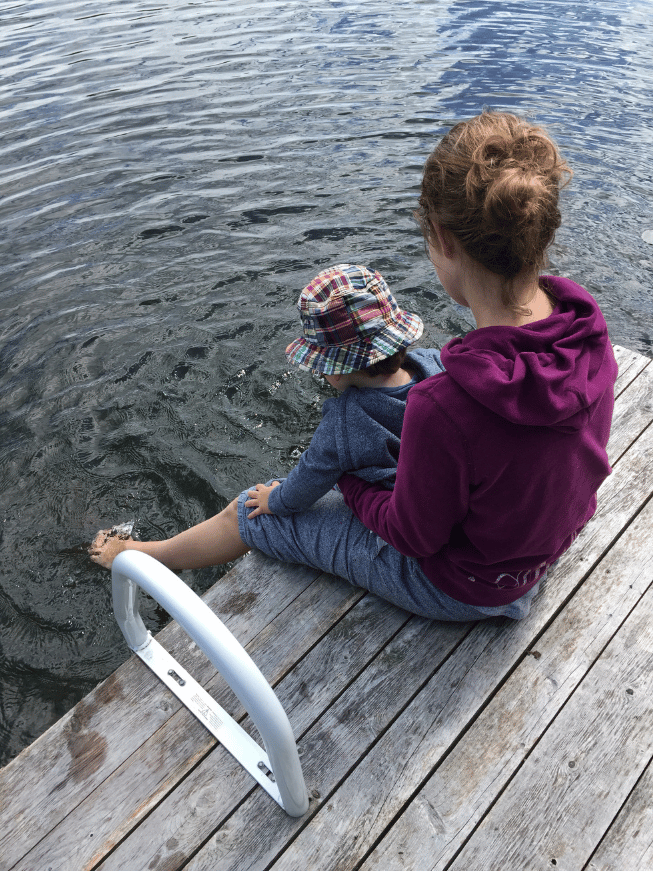
Storyteller: Caitlin Sigouin, MSW RSW @ Shift Collab
“By leaning into what I considered a weakness, I’ve realized that it is one of my greatest strengths as a therapist. I have such empathy and compassion for my clients and have been able to develop very deep and meaningful connections as a result.”

This story was originally published in Issue 1 of Lamplight. Lamplight is an Unsinkable publication designed to be a home for mental health care providers. It’s published digitally throughout the year, and once in print every October 13th.
As a therapist who specializes in supporting parents navigating their journey raising children, it seems I check all the boxes: I have the knowledge and skill set to support them through this messy and beautiful time; I have years of schooling and over fifteen years of experience in the field; I’ve read the books and taken the trainings; I’ve done my own therapy and felt like I was in a good emotional place; and I was able to support other parents and children with their big emotions during challenging times in their lives.
But then I became a parent and suddenly, none of this mattered. In truth, I’m a therapist supporting parents to regulate their emotions while I struggle at times to regulate my own.
Becoming a parent was an intentional choice and something I truly wanted. My journey to becoming a parent wasn’t easy, filled with multiple rounds of IVF and two pregnancy losses. When I finally became pregnant and gave birth, I was elated. I knew that there would be difficult moments and I imagined myself being the calm and caring parent who would always be able to provide comfort—with endless patience—because that’s how I showed up for my clients.
In the early years of parenting, I wasn’t surrounded by an able and willing community to support myself and my children on our journey. Further, I wasn’t even fully aware of what I was missing, nor that the absence was taking an emotional toll. I was so happy to be a parent and believed that this, alone, had to be enough. Wasn’t I unforgivable if it wasn’t?
While I encouraged other parents to prioritize their needs and focus on self-care, I wasn’t doing this myself. My time and energy were poured into my children, and since I had wanted them so much, I assumed I would be able to manage everything that came with parenthood, unconsciously layering stigma and shame onto myself if the thought to ask for help arose. Given my education and experience, I should be able to handle it. Right? Not quite.
My eldest didn’t sleep through the night until he was 4.5 years old. He’s also neurodivergent with sensory-specific sensitivities—“simple” tasks like preparing meals and getting him dressed can be incredibly demanding, often consuming my mental energy. The foods he will eat are also very limited, alongside finding clothes that don’t bother him. At times, navigating this feels nearly impossible. I was quickly burning out.
I started creating a community of friends with a focus on the joy this could bring my children. When I first reached out for support, other parents often met me with unhelpful suggestions, such as not giving my son other options at meals (“he will eventually eat what you’re serving”). The blame was both unintentionally and intentionally placed back on me as the parent: I was ‘causing’ or ‘enabling’ him to have these difficulties. The confidence I had in myself and my parenting capacities began to be impacted. I felt like I was failing.
Working with other professionals who supported me and validated my experience was one of the most helpful supports toward getting myself back on track. I’ve been thankful, as well, to connect with and surround myself with a group of parent friends who are kind and understanding. This experience in my parenting journey allowed me to experience firsthand the type of support that feels good and catalyzes positive change. Collective care is powerful.
Throughout the past two years, I’ve begun to prioritize my own needs and use the support available to me. Instead of turning away from hard feelings, I’ve tried to embrace them and use this vulnerability to show up, hold space, and be authentically myself with my clients. By leaning into what I considered a weakness, I’ve realized that it is one of my greatest strengths as a therapist. I have such empathy and compassion for my clients and this is reflected in my interactions with clients.
I’ve learned that being a parent is so much more than knowledge and experience about raising children. We need a community that validates the struggles we’re facing and provides support where we feel safe to discuss the more difficult moments. Acknowledging the struggles we’re having does not in any way minimize the joy and love we have for our children. When we’re able to hold space for emotions that feel conflictual, we actually feel the heavy weight being lifted.
Shame lives in silence and can be so isolating. Speaking with others and being honest with myself about how I’m doing allows me to show myself compassion and understanding. Some days are easier than others and it is still a journey for me. I’m getting better at asking for help and utilizing my support system. There are moments where I still feel guilt and shame for struggling, but I remind myself that I’m doing the best I can.
I’m incredibly lucky to have met other parents during this period who have turned into true and long-lasting friendships. Having a community of people who support you—and who you can support—is such an important piece of parenting. Some people have a built-in support system of family and friends, but many of us have to work to cultivate and build our system. I find that the more I show up authentically and share the hard pieces, the more others open up as well, allowing for deeper and more meaningful connections to be formed.
I’ve also found that allowing my clients to see me as human normalizes the experience of struggling and seeking help. Feeling seen and heard are primary needs of human beings.
Growth doesn’t come from perfection, but from acknowledging where we’re struggling and seeking connections and support to identify where we’re getting stuck. I often remind myself, and my clients, that aspiring to be perfect for our kids can be dangerous because it sets the standard impossibly high without allowing room for failure.
Showing that we are doing our best, identifying when we need help, and reaching out offers an important model—that there is no shame if they need help or make a mistake. I can remind my clients of this repeatedly, but it’s meaningless if I’m not following it myself. Our actions will always carry more weight, and I’m learning every day. It’s becoming easier to offer myself this grace.
I’m a much better parent and therapist when I take my own needs into account, and I try hard to remember this.