
Storyteller: Maria Estrada
Dear Lamplight Community,
When I first thought about the relationship between storytelling and mental health care work, I noticed how easy it is to focus on diagnosis and treatment plans. They’re often analytical, structured, and organized into charts and spreadsheets. But the heart of the work is more human—always happening.
On how lightning works, canada.ca says:
“There is still some debate in the scientific community about how the electrification of clouds occurs. However, scientists agree that positive and negative charges must separate within a cloud for lightning to take place.”
But it’s only after these currents meet that we see ‘lightning’ in the sky.
You might say another form of light after lightning is visible when care providers help those they work with. Or when parts of our stories meet…
Every person wears and carries stories that can’t be transcribed into a file or even a notebook. Stories aren’t as polarized as lightning, but they do carry interacting pain, joy, shock, and triumph.
“Care provision” often appears in the same sentence as “holding space,” which to me means holding not just what’s collected in clinical documentation, but what’s left—what exists between us in care spaces, whether spoken or not. Sometimes, what isn’t said is the story, too.
A story’s building blocks are relationships, culture, resilience, and meaning-making. When I listen, I don’t just listen for symptoms. I listen for the way stories carry information that numbers can’t actually capture. They tell us what matters to someone when it’s painful, what’s been protected, and what’s still possible.
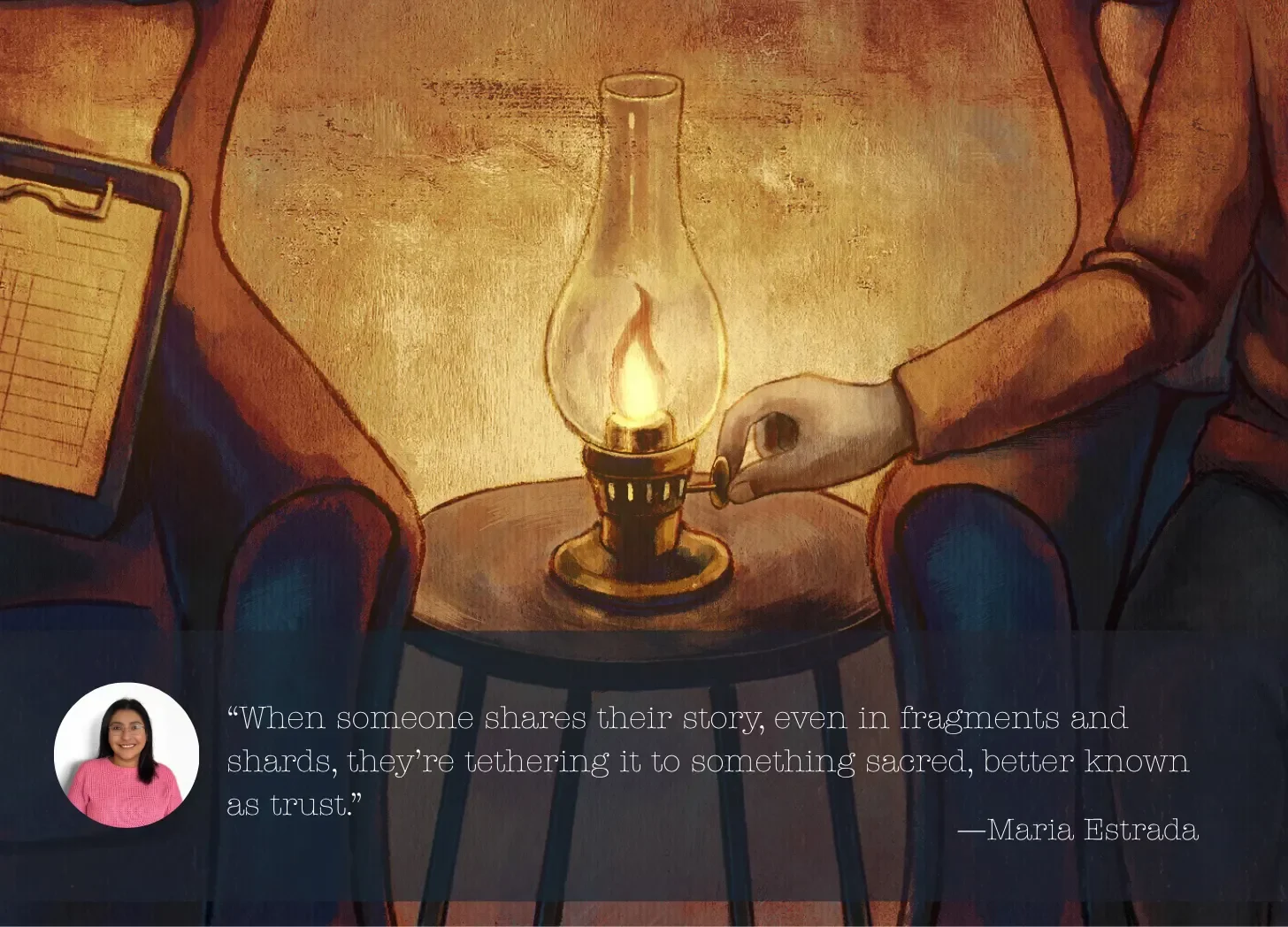
I often ask myself if I’m listening to correct or listening to understand; rushing to labels or staying curious long enough to see the person behind them? When someone shares their story, even in fragments and shards, they’re tethering it to something sacred, better known as trust. Trust is healing’s catalyst, and in a way, the bridge between understanding experience and expanding it by inviting us to be part of that process. This is how life-changing shifts happen.
As care providers, we don’t exist outside of storytelling, either. The instance of storytelling isn’t a liminal space. We bring our own values and lived experience into the room, whether it’s offered verbally or not. Importantly, lived experience isn’t story—our lives don’t have clear shapes or forms like we’re taught in school. But our lives can wear the shape of a story the same way we find rest in a bed at night—story helps us hold pain, memory, joy, and grief. And as care providers, we offer the skill, intuition, and care to help others transform their values and lived experience into a story, if that’s supportive for them. Sometimes it’s not. And that’s okay, too.
In this way, storytelling isn’t the extra part of the work. It is the work. It’s how we understand people, how we build relationships, and it’s often where healing begins.
I’m grateful and excited to be writing this monthly letter for you—more to come.
Until next time,
Maria
This interview discussion between Mikaela Brewer and Maria Estrada was originally published in Issue 2 of Lamplight. Lamplight is an Unsinkable publication designed to be a home for mental health care providers. It’s published digitally throughout the year, and once in print every October 13th.
I would love it if you’d be open to sharing a bit about your ancestry, land, people, and what leaving so young (and returning so recently as an adult) felt like mentally, emotionally, physically, and spiritually.
I was born in Peru, and I was very young when I immigrated to Canada. Coming here, I felt like I’d lost my identity. I left my heritage behind before ever incorporating its beliefs and teachings into my life. I was focused on surviving and learning English—navigating all of those associated pieces.
As I grew up, I felt like there was a piece of me missing: learning more about my Indigeneity. I took a course when I was in college—an elective called Indigenous Studies. Part of the course was an essay on Indigenous people in Canada. I remember reading through the assignment and asking the professor if I could write about my ancestry—the Indigenous people of Peru.
The professor looked at me, quickly replying, “Oh, my God. Absolutely.”
I didn't tiptoe, but I didn't feel validated—or didn’t feel right—saying that I come from Indigenous lineage.
I was asking for permission from my professor, who was an Indigenous Elder. I said, “You know, I’m not sure if this is appropriate because I’m not Indigenous?”
She looked at me with the kindest eyes and responded, “No, you are Indigenous. You are part of Turtle Island.”
I pushed back a bit and said, “Well, no, because I wasn’t born here.”
I didn't know much about my history, and she was the one who opened my eyes to Peru. There, everybody’s lineage is Indigenous and Spanish. That term would be Métis, here.
So, she offered, “You’d be considered Métis. Don’t feel like you need to push back on something that is yours.”
From this conversation I wrote my essay. I connected with my Grandma because I needed to know her wisdom. She always honored her Indigeneity—always honored Pachamama (“Mother Earth” in Quechua) and her ancestors—and that’s what I forever absorb from her.
As she walked me through my essay and shared in-depth knowledge of the Incan Empire and the different methods that they lived by, she emphasized that these cultural practices never left the people of Peru. They never left. Even so, because of colonialism, there’s a strange shame around being Indigenous. And that’s what's shocking.
I gathered and wrote all of the lessons and information that my Grandma shared into my essay, and the process felt like the piece I’d been missing—the piece that wholly incorporated what mental health means because it includes my historical background.
When I speak with my clients and the people who I support, it’s never just about that person. And it’s never been just about their caregivers. It’s about the historical big picture of what trauma happened to a family or a people.
I soon realized that not many care providers approach it like this. When I had the opportunity to return to Peru three years ago, I wanted to go because I wanted to learn more about my people. I made sure that the guides were Indigenous people from that land. Knowing them was the puzzle piece I was missing—that I didn’t know I needed. It wasn't just, “Oh, I’m Latina.” It was much more than that. It was: I do have Indigenous history and although my family doesn't honor it the same way my Grandma and I do, I still ensure that within my immediate family, my home carries on.
So beautiful. You led into this a bit, but I’m wondering how this informs your work with Unsinkable Youth, perhaps especially with those who are trying to reclaim a decolonized connection to their land and their people while navigating Western mental health systems?
Whether I’m working with youth or staff in the program, I make sure to honour what they want to honour. I have no say in what they should or shouldn’t do, but what I do know is that it’s an honor and a privilege when people allow me to walk with them through their journey, whether that’s exploring their indigeneity, mental health, or spirituality. I honour a holistic approach very deeply because nobody owes me anything. Nobody owes me anything just because I’m the manager of a program. They get to lead. My job, really, is to be in the passenger seat with a map, but they’re driving.
That's such a beautiful way of thinking about it and connects wonderfully to something we talk about all the time: The process and practice of helping people nurture a relationship with themselves, their ancestry, their past—things we don’t immediately think of as mental health care—is suicide prevention. It is mental health care. And that’s so important for the recipient of care, but also for the provider and the relationship between the two.
Yes—they’re their own experts and they know themselves better than anybody. The approach of suicide prevention is using harm reduction. We want to reduce the harm of whatever they’re experiencing. I can’t eliminate it—my job is not to save or to fix because they’re not broken.
What I do know is that people deserve options when their power has been taken away. My job is to give them as much power back as I can provide by offering them options. That is suicide prevention. That is harm reduction.
Absolutely. And one thing you do wonderfully well is not forcing folks into a particular treatment pathway or “one route” to heal. That’s what so many Western mental health practices feel like: there are one or two pathways versus asking: What’s the full-picture story of each individual and how do you support them?
That’s so important to highlight because there isn’t a one-size-fits-all mentality with supporting people—it’s a lot of mix and match. But it’s also not my job to mix and match for anyone. My job is around education. I used to have this sweater that said, “Just Say Know.” And that’s the greatest approach.
You get to decide what you want to do, and if it’s none of the options because you’re not ready, then we put them on the backburner because they’re not a priority right now.
I go back to the individual and ask, “What is your priority right now?” And we work from there.
Because there were so many times, even along my journey, that I heard language like, “To be clean and sober, you have to be attending Narcotics Anonymous.” For many people, that’s not the case.
I love that you said it’s not a one size fits all approach—that’s so applicable to what we’ve been talking about with ancestry, indigeneity, etc. And you alluded to this already, but your role as a wealth of wisdom, of course, is connected to your own story and your own mental health and how you’ve come about your knowledge. Thinking about the main theme of Lamplight, which is how care providers, in the various spaces that they're in, think about their own mental health—caring for it and also offering it as a connecting point. So I’m wondering: How do you take care of your mental health, and also share your story as a bridge with the people you work with?
There’s a fine line between the clinical and lived experience sector. And although I understand the clinical—I’ve been in those roles—it feels like a square: Of what can and cannot do, and what you can and cannot say. I get those pieces because, of course, you don’t want to say something harmful. And at the same time, I also know the value of sharing your lived experience. How do we get to a place where we can mix clinical approaches and lived experience, because everybody who goes into this field has lived experience. For me, I see sharing my lived experience as honouring it.
When I was doing clinical counseling, I was able to say, “I understand that feeling. Maybe I didn’t go through the same thing, but I’ve experienced that feeling before.” And that, in and of itself, is so powerful.
But I wish, sometimes, that I could have said, “I have been in your shoes and it feels really icky. I’m sorry that you’re going through this. How can we work this out?”
I take the holistic approach of saying ‘we’ all the time, because I don’t want them to feel alone in this journey; that I’m just waiting on the other side saying, “Okay, come over this way.” It’s about a we. What can we do?
I also ensure that I’m honouring my lived experience by not putting it aside, because that’s part of my own healing journey: To not push my experience out a window or ignore it. Whether I honour it in my car after a session or a call, I sit with those feelings in honour, acknowledge that what I went through is valid, and hold how I understand what a client is going through. I sit with this until the feeling feels seen and is safe to let go of.
It’s vital to take that time to regenerate after holding space because I know so many mental health care providers, in whatever capacity, go from session to session, back to back to back. And that format doesn’t offer space to process and acknowledge that yes, you’re holding space for someone else—and of course there has to be a boundary so that you’re protecting yourself and not absorbing everything that’s being shared by the other person—but you’re also a human being. Your emotions are going to resonate and experiences are going to resonate. And you need space to allow that to be, like you said. An emotion needs time to move through your whole body. And that time is precious.
I have been in those situations of being back to back to back. That was me yesterday. I was back to back from 9 a.m. until 5 p.m. And I’m a person. I need to breathe. I need to be ready for the next thing and maybe I don’t have the ability to cancel an appointment or meeting.
But what I do have control of is saying, “I’m going to be five minutes late.” And in those five minutes, I’m going to go to the bathroom and just be. Or I’m going to drink water and just be.
It’s these little actions that fuel me enough to keep going. It’s the same thing I did when I was in case management: I would go to the bathroom and I wouldn’t do anything but just ground myself. I honour whatever I feel or need, and then I go back. I know care providers feel they can’t do this because it seems like disputing the obligation to keep going. But I don’t think that’s true. Saying, “I’m going to be five minutes late” doesn’t make you any less of a worker, it just makes you human.
