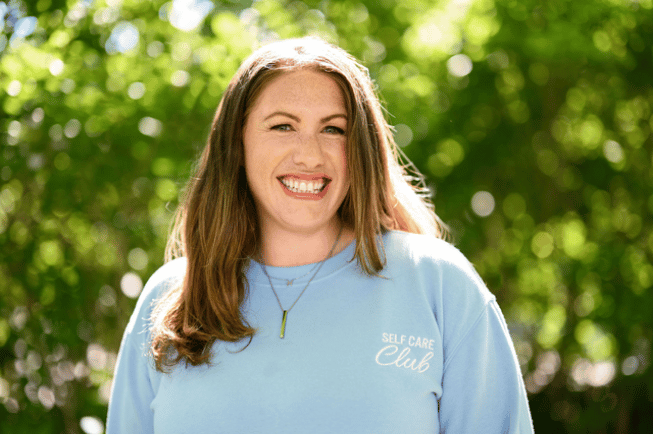
Storyteller: Hailey Hechtman
“For so long, I believed that taking care of myself was selfish. That I was only valuable if I was giving everything I had to others. That to step back, to rest, to say no, was to fail. But I have learned that true impact doesn’t come from martyring ourselves. It comes from sustainability, from balance, from knowing that we cannot control the emotions or behaviours of others—only how we show up for ourselves and for them.“
This story was originally published in Issue 2 of Lamplight. Lamplight is an Unsinkable publication designed to be a home for mental health care providers. It’s published digitally throughout the year, and once in print every October 13th.
From as early as I can remember, I was drawn to understanding people—their emotions, behaviours, and what drove them. Growing up in a volatile family environment, I learned that my greatest survival skill was predicting the emotions of those around me. If I could anticipate their reactions, I could navigate my world with greater safety. I became a listener, a support system, a confidant—even when I was too young to bear such a weight.
At first, this wasn’t a burden—it was a role that gave me purpose. I was the good one, the one who didn’t cause trouble, the one who could be relied on. And in that, I found validation. In moments of chaos, I knew exactly who I needed to be: calm, collected, in control.
This early conditioning shaped my deep interest in people and emotions, ultimately leading me to study psychology. By the time I reached university, my natural inclination to support others led me to volunteer at a crisis line. It was there that I discovered something profound: the power of simply being there for someone in their darkest moment, offering them a space to be heard. That experience changed me—not just because I saw the impact of mental health support firsthand, but because I began to recognize that helping people wasn’t just something I was good at; it was something I needed.
But what I didn’t realize then was that this deep need to be helpful, to be needed, came at a cost.
The Professional and the Personal: A Hidden Battle
This drive to support others became the through-line of my career. From frontline crisis support and peer mentorship to launching the first-ever distress line in the Yukon, to leading organizations supporting adults with neurodevelopmental disabilities, to now guiding Unsinkable as a leader in digital mental health storytelling—I have always held an unwavering belief in people. In their strengths, their resilience, and the power of community to make us better.
But what I want to emphasize today is that these two narratives—the professional and the personal—are deeply intertwined.
Some of you may know that I was first introduced to Unsinkable as a storyteller. Ishared my own mental health journey—one marked by nearly a decade of battling an eating disorder and anxiety.
For much of my career, I was simultaneously supporting others and struggling in silence. I had spent so much of my life compartmentalizing my emotions, setting them aside to focus on helping others, that I convinced myself I was fine. I wasn’t fine.
I poured everything into my work, using it as a way to avoid my own struggles. I threw myself into my role, taking on more, saying yes to everything, filling my days with purpose so that I wouldn’t have to sit in the discomfort of my own emotions. I was highly functional, highly successful, and deeply unwell.
I told myself I was succeeding—receiving external validation for my leadership while internally battling my own declining health. I saw myself as capable and driven, but the truth was, I was running.
The Breaking Point
The turning point came when I started experiencing resentment. A deep dissatisfaction with work I had once loved. A growing exhaustion. A wariness of the people around me.
One moment stands out vividly.
My team had organized a beautiful birthday celebration for me. They had made a custom strawberry shortcake—my favourite—and gathered with joy to celebrate. It should have been a moment of warmth and gratitude.
Instead, all I felt was overwhelming anxiety.
I wasn’t thinking about the kindness of the gesture. I wasn’t thinking about how loved I was. Instead, my mind was consumed with a single thought: How can I avoid eating a piece without disappointing anyone?
That was the moment I truly saw how much space my eating disorder occupied in my mind and life.
I realized that, for years, I had believed I was holding space for others while ignoring my own needs. The truth was, I wasn’t truly present for either. I had been using my work as a means to avoid facing myself.
And I wasn’t alone.
The Culture of Self-Sacrifice in Helping Professions
This pattern—of pouring oneself into work at the expense of personal well-being—is one I have seen repeatedly in the nonprofit and mental health sectors.
Many of us enter this space driven by passion, only to find ourselves trapped in a cycle of burnout, mistaking self-sacrifice for impact. We become so focused on helping others that we forget that our well-being matters, too.
For so long, I believed that taking care of myself was selfish. That I was only valuable if I was giving everything I had to others. That to step back, to rest, to say no, was to fail.
But I have learned that true impact doesn’t come from martyring ourselves. It comes from sustainability, from balance, from knowing that we cannot control the emotions or behaviours of others—only how we show up for ourselves and for them.
Rewriting the Story
Now, more than five years into my recovery, I take a different approach.
✅ I set boundaries around my time and energy.
✅ I create space for joy outside of work.
✅ I give myself permission to say no.
✅ I invest in my mental health through fitness, writing, and meaningful social connections.
I’ve learned that while my past approach may have been effective in the short term, it was not sustainable. It drained me, leaving me depleted, resentful, and disconnected from myself.
I’ve also learned that rest is not a reward—it’s a necessity. That saying no doesn’t mean you don’t care—it means you’re protecting your capacity to care. That we are not meant to carry everything alone.
A Message for Those Balancing Care for Others and Themselves
To anyone who feels like they’re drowning in their own expectations, who is struggling to balance their work, their passion, and their mental health—I want you to hear this:
🛑 You are not selfish for needing rest.
🛑 You are not weak for setting boundaries.
🛑 Your well-being is not a luxury—it’s a necessity.
The work we do is important. But it should never come at the cost of our own mental health.
Holding space for others starts with learning to hold space for yourself.
